Currently Empty: $0.00
 NEW
NEW
📢 ANNOUNCEMENT
Explore →
All Courses
Explore our complete course catalog.


Evaluate apparel business models and build a unit economics framework including COGS, Landed Costs, and Retail Margins.
Understanding financial fundamentals is essential to maintaining business longevity. Clothing startups fail primarily due to poor cash flow management and incorrect pricing strategies.
| Model | Upfront Capital | Control Over Quality | Profit Margin Potential | Speed to Market |
| Print-on-Demand (POD) | Very Low ($0–$500) | Low | Low (15%–30%) | Fast (1–3 Days) |
| Private Label / Wholesale Blank | Low-Medium ($500–$2,500) | Medium | Medium (40%–60%) | Medium (2–3 Weeks) |
| Custom Cut & Sew | High ($3,000–$10,000+) | High | High (60%–80%) | Slow (2–4 Months) |
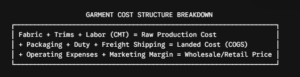
COGS (Cost of Goods Sold): The direct cost of producing a garment, including materials, direct labor, and manufacturing overhead.
Landed Cost: The total cost of a garment once it arrives at your door (Production Cost + Duty + Freight + Insurance + Customs Clearing).
Keystone Pricing: Pricing strategy where the retail price is calculated by multiplying the wholesale cost by two (or production cost by 4x–5x for DTC).
Calculate Direct Manufacturing Cost:
Calculate Landed Cost:
Set Retail Direct-To-Consumer (DTC) Price:
Maintain a target gross profit margin of at least 65%–75% on DTC sales to absorb digital ad costs and returns.
Always factor packaging, woven neck labels, hang tags, and shipping materials into your initial COGS calculations.
Mistake: Setting retail prices based solely on competitor pricing without factoring in landed costs and shipping fees.
Correction: Calculate your exact landed costs first, then verify if your market supports the required markup.
A DTC T-Shirt brand manufactures a heavy-cotton tee at $7.50 unit cost. Shipping, customs, and poly-bag packaging add $2.50. The Landed COGS is $10.00. The brand sets the DTC retail price at $45.00, yielding an $35.00 gross profit per unit (77.7% gross margin) to cover marketing and operations.
Scenario: Alex launches an activewear line pricing leggings at $35.
Landed Cost: $18.00.
Gross Profit: $17.00 (48.5% Margin).
Ad Cost per Acquisition (CAC): $22.00.
Outcome: Alex loses $5.00 on every sale despite making revenue.
Solution: Alex redesigns the garment specs to lower landed cost to $12.00 and repositions branding to support a $58.00 retail price.
Build a spreadsheet calculating the Landed Cost and Retail Price for a garment using hypothetical raw material, labor, freight, and duty values.
Fill out the Garment Pricing Calculator Sheet for 1 product:
Material Cost: $4.50
Labor Cost: $3.50
Packaging & Trims: $1.20
Freight & Duty per unit: $2.30
Calculate: Total COGS, Keystone Wholesale Price, and 4.5x DTC Retail Price.
Accurate costing prevents cash flow issues. Ensure your product price structure supports marketing acquisition costs, platform fees, and future expansion.
Pricing must be built bottom-up from Landed COGS, not top-down from guess-work.
Aim for a minimum 4x multiplier on Landed COGS for DTC retail pricing.
Factor shipping, customs fees, and packaging into unit cost calculations from day one.