Currently Empty: $0.00
 NEW
NEW
📢 ANNOUNCEMENT
Explore →
All Courses
Explore our complete course catalog.


Draft an industry-standard Tech Pack including flat sketches, Bill of Materials (BOM), measurement spec sheets, and point-of-measurement (POM) guidelines.
Factories do not sew garments from artistic fashion illustrations or photos. They build garments based on a Tech Pack—the contractually binding technical blueprint of your product. An incomplete Tech Pack leads to miscommunication, incorrect sizing, wasted sampling fees, and unusable inventory.
TECH PACK CORE COMPONENTS
┌───────────────────────────────────────────────────
│ 1. Flat Technical Drawing (Front, Back, Detail Callouts) │
│ 2. Bill of Materials (BOM – Fabric, Thread, Trims) │
│ 3. Measurement Spec Sheet (Graded S, M, L, XL Dimensions) │
│ 4. Construction Details (Stitch types, Seams, Hemming) │
│ 5. Labeling & Packaging Specs (Polybag, Hangtag placement)│
└───────────────────────────────────────────────────
Tech Pack (Technical Package): An instructional document created by designers to give manufacturers all necessary specs to produce a garment.
BOM (Bill of Materials): A comprehensive list of every raw material required to construct a single finished garment (fabric, lining, threads, zippers, buttons, care labels).
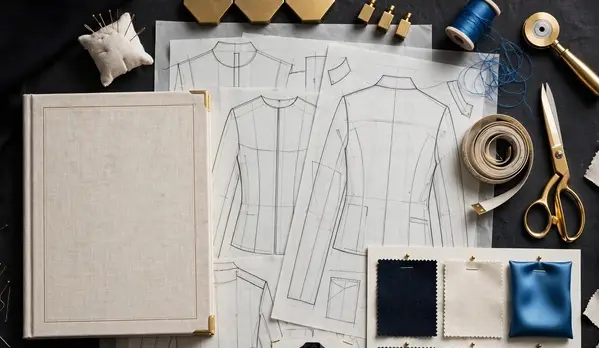
Flat Sketch (Technical Drawing): A proportional, 2D black-and-white vector drawing showing garment construction lines without shading or artistic styling.
POM (Point of Measurement): Specific positions on a garment measured to ensure accurate sizing across production runs (e.g., chest width 1″ below armhole).
Create Technical Flats: Draw front, back, and interior views of the garment using clean black vector lines. Call out special features like pocket placement, stitching style, and hardware.
Compile the Bill of Materials (BOM):
| Item Component | Description / Fiber Content | Color Code (Pantone) | Quantity per Unit | Supplier (if known) |
| Main Fabric | 100% Organic Cotton French Terry 400 GSM | TCX 19-4007 (Jet Black) | 1.4 Yards | Mill A |
| Ribbing | 95% Cotton / 5% Elastane 2×2 Rib | TCX 19-4007 (Jet Black) | 0.3 Yards | Mill A |
| Neck Label | Woven Satin Label 30x50mm | White / Black Text | 1 Piece | Trim Vendor B |
| Zipper | #5 YKK Metal Two-Way Zipper | Antique Brass | 1 Piece | YKK |
Define Points of Measurement (POM Sheet):
Measure an existing sample garment that fits well to build your base size (e.g., Size Medium).
Define crucial POMs: Chest Width, Body Length, Shoulder Slope, Sleeve Length, Neck Opening, Sweep/Hem Width.
Use standardized Pantone Fashion, Home + Interiors (TCX/TPG) color codes rather than generic color names to avoid dye-lot discrepancies.
Provide clear seam construction guidelines (e.g., “Flatlock stitching on activewear seams for flat comfort”).
Mistake: Sending reference photos of competitor garments to a factory and expecting accurate fit without precise measurements.
Correction: Provide precise physical measurements for every size point in your Spec Sheet.
Professional apparel brands like Patagonia or Nike use standardized Tech Pack templates where every seam tolerance is specified within a +/- 0.5 cm margin, eliminating factory guesswork.
Scenario: Designer Leo sends a sketch and photo of a hoodie to a factory in Vietnam without a Tech Pack.
Result: Factory produces a hoodie with thin 180 GSM fabric instead of heavy fleece, armholes that restrict movement, and incorrect zipper sizes.
Cost of Error: $350 spent on unusable sample + 4 weeks lost time.
Solution: Leo re-submits using a standard Tech Pack template detailing 420 GSM fleece, dropped shoulders, and YKK zipper specs. Sample 2 matches expectations.
Measure a favorite garment in your wardrobe using a flexible measuring tape and fill out a basic 5-point measurement specification table.
Draft the Bill of Materials (BOM) section for a graphic T-shirt, including main body fabric GSM, neck ribbing spec, care label placement, and neck tape dimensions.
A Tech Pack is your legal and technical contract with a manufacturer. Clear specs yield accurate production runs and protect you against factory errors.
Never rely on visual illustrations alone; factories require vector flats and dimensional spec tables.
A complete Tech Pack includes Technical Flats, BOM, Spec Sheet, Construction Notes, and Packaging Specs.
Standardized color codes (Pantone TCX/TPG) prevent color matching mistakes.